
Is Your Gym Floor Selling PT For You?
Your Quietest Salesperson
Every member who walks across your gym floor is getting a sales pitch, whether you meant to give one or not.
They see who's coaching and who's scrolling. They notice whether PT sessions look fun or punishing. They clock whether trainers say hello or look straight through them. Long before anyone asks "have you thought about PT?", the floor has already made the case for or against.
The good news is that you're in control of most of it. How you spend your time between sessions, where you train your clients and how you present yourself can turn the floor into a steady source of new clients, without any hard selling.
Visible Coaching: What Trainers Do Between Sessions
The hour between clients matters as much as the hour with one. In one study of UK gym members, only 37% said fitness staff spoke to them on their last visit. Yet nearly 90% said they value it. That gap is your opportunity.
Be on the floor, not behind your phone. Members can't tell the difference between you messaging a client and you scrolling social media. Do your admin away from the floor, or between sessions in the staff room.
Give, don't pitch. A quick tip on a cable setting or a better squat stance shows members what your coaching feels like. Ask for permission to help, keep it short and friendly, then leave them to it. Aim for three of these conversations every shift.
Coach out loud. During sessions, let your energy be seen and heard. Members watching a client hit a PB and high-fiving their trainer, are seeing the product in action.
Look approachable. Wear your branded top and name badge, and keep your headphones out. Standing with your arms folded by the water fountain sends the opposite message to the one you are aiming for, be open and friendly.
Make your floor time count. Find out when your ideal clients train, whether that's the early-morning commuters or the mid-morning parents, and make sure you're visible then. Or, if you are more flexible in who you want to train than when, know what time you want to fill in your diary and make that the time you are there. An hour on the floor at the right time is worth more than three at the wrong one.
Make sure people know what you do. It's easy to assume members who see you in the gym automatically know you are personal trainer. This is not the case. Get used to bringing up what you do in a non sales focused way.
Let people know you have spaces available. A handy approach is to ask them if they know anyone who might be interested or to mention you if they hear someone talking about having PT sessions.

Where You Train Your Clients
If all your sessions happen in a back studio, most members never see what you do. Where you coach is part of your marketing.
Train where people walk past. When a client is happy to be seen, use the most appropriate space nearest the main walkway. Members heading to the treadmill get a free preview of what a session with you looks like.
Show the range of people you train. If your visible sessions are always your most advanced lifter, you'll put beginners off. Where possible, let members see you coaching a range of clients.
Respect your clients' comfort. Some clients don't want an audience, and that comes first. Ask them where they'd prefer to train, and keep the visible spots for the ones who enjoy it.
Don't hog the kit. Members who wait for a rack while you hold it for 20 minutes with your client come to resent PT, and you. At peak times, plan sessions that use minimal equipment, share equipment or move between stations, and offer a member the rack between sets.
Your Profile, Your Proof
When you're busy with a client, your profile board and your results do the talking for you. Make sure they say the right things.
Make your profile human. Use a friendly photo, say what you specialise in and who you love working with. "Helps nervous beginners feel at home in the weights area" says far more than a list of qualifications. (We covered this in more detail in our blog on gym profile boards.)
Collect client stories as you go. The best ones go beyond weight loss: a first pull-up, running again after injury, lifting a grandchild without back pain. Ask happy clients if you can share their story, and always get written consent before using a name or photo.
Make it easy to start with you. Members shouldn't have to work out how to book you or stalk you to grab you between clients. Add your prices, a free taster offer and a QR code to your profile, and carry a few cards or a booking link on your phone.
Keep it current. An old photo or a specialism you no longer offer tells members you're not paying attention. Check your profile every month and update it whenever things change.
From Floor To First Session
Most members don't buy PT the first time they see it. They move through a few small, free moments first, and each one builds trust.
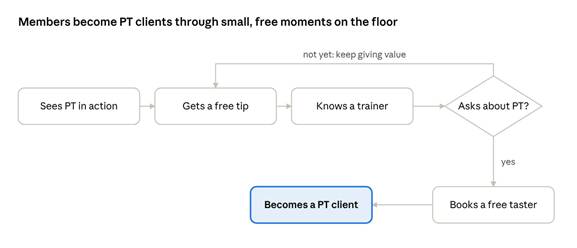
From gym floor to PT client · 5 steps, 1 decision
The key is the loop. When a member isn't ready, the answer isn't a harder sell. It's another useful tip and another friendly conversation. When they do ask, make the next step easy: a free taster session booked there and then, not "grab a leaflet from reception".
Your 10-minute floor audit
At the end of your next shift, run through this checklist honestly:
- ☐ I spent time on the floor without my phone in my hand
- ☐ I gave at least three members a useful tip, with no sales pitch
- ☐ I learned or used at least one new member's name
- ☐ At least one of my sessions happened where members could see it
- ☐ I didn't keep members waiting for kit during a session
- ☐ My profile is up to date, with my photo, specialisms and how to book
- ☐ I know how I'd book a member in for a taster on the spot
- ☐ I told someone what I do
- ☐ I asked someone if they knew anyone interested in PT
If you ticked fewer than five, the floor isn't doing the most it can to help you. You don't need a sales script to fix it. Be present, be generous with your knowledge, let people see you coach, and make it easy to take the next step. Do that every shift, and the enquiries will come to you.
For more check out the How To Get More Leads At A Commercial Gym webinar.
Non members* can sign up for a 2 week free trial to access this and hundreds of other videos, downloads and courses covering every aspect of becoming the personal trainer you want to be. Sign up here
*New members only